New publication: Bruno et al. (2026) J Insects Food Feed 12(7), 1137-1147
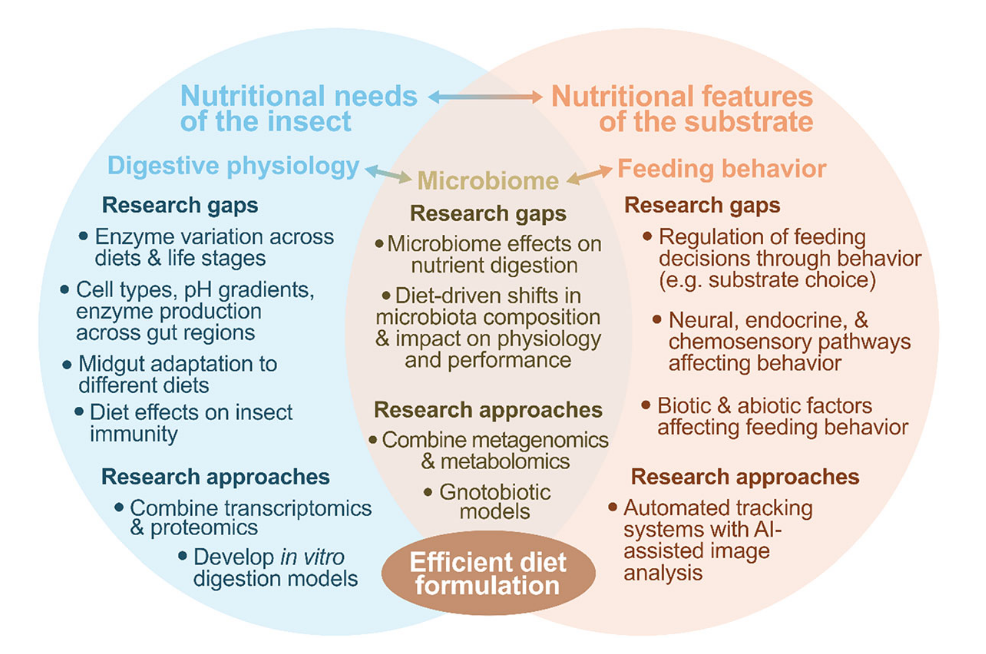
In this article, we argue that the next major advances in insect rearing for food and feed will come from mechanistic understanding of three interconnected domains—microbiome–nutrition interactions, feeding behaviour, and digestive physiology, rather than from further empirical diet tweaking alone. We highlight how current work on black soldier fly, mealworm, and crickets still leans heavily on growth and FCR readouts plus descriptive microbiome surveys, and we call for integrated, quantitative, and standardised approaches (multi-omics, behavioural tracking, digestion models, gnotobiotic tools) to build predictive, species-specific feeding strategies and more robust, welfare-aware insect farming systems.